
What is Cardstack?
Cardstack is an open-source framework and consensus protocol that
creates a centralized software ecosystem that can challenge today's
super-power digital, making block chains workable and scalable for mass
market.
In other words, making the leap for block chains on every floor of the software pile, Cardstack adds a revolutionary experience that makes block chain technology workable and measurable; creating a centralized software ecosystem that can compete with digital platforms. Centralized technology drives us to silos and captures the value we create. Early centric technology, such as bitcoin, promises chaining blocks, but also benefits the bad guys.
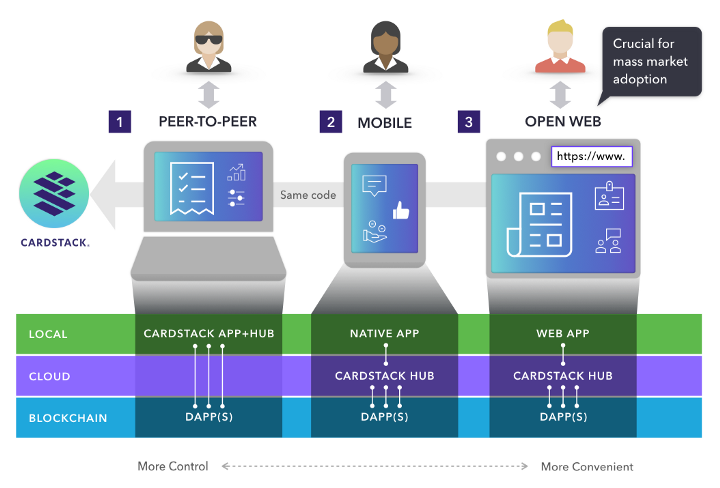
The Cardstack decentralization approach allows dominant users to act as their center; so that interactions with applications and services running on different network topologies flow through user-controlled software stacks.
In other words, making the leap for block chains on every floor of the software pile, Cardstack adds a revolutionary experience that makes block chain technology workable and measurable; creating a centralized software ecosystem that can compete with digital platforms. Centralized technology drives us to silos and captures the value we create. Early centric technology, such as bitcoin, promises chaining blocks, but also benefits the bad guys.
The Cardstack decentralization approach allows dominant users to act as their center; so that interactions with applications and services running on different network topologies flow through user-controlled software stacks.
The concepts that make up this field problem are mainly:
- The App Store Period turns the software feature into an independent, original application; These applications generally do not communicate with each other and others want to choose from some overlapping features to shape the user's workflow.
- While the software is floating in the cloud, the user has to manage multiple subscriptions to the software product (SaaS) as a cloud-based service and choose the right plan to optimize the cost for all the required features.
- The emergence of block chains and decentralized applications (dApps) has made it difficult for users to obtain and manage service symbols for every function that makes up the software stack.
Cardstack solutions in this regard are:
Cardstack creates a new layer of experience that helps users manage
their interactions in Apps (d) while maintaining collective market
acceptance of epistemic centralized technology in open ecosystems.
In short, the new orchestration approach should put users at the center
and let them act like their own center; so that interaction with
applications and services occurs through user-controlled stack software.
In addition, the arrangements required to coat a decentralized Internet
experience can be intuitively done by suggesting the flow of subsequent
movements by chaining each card by changing every state of the
application into a visual setting of the relevant information.
The process of centralizing the software ecosystem behind a stack of
cards experiencing a centralized Internet experience can be done
piecemeal by letting the general cloud service change when ready to
change the block chain.
Business card features
With Cardstack, end users can mix and match features from multiple
applications or DAPP without worrying about the complexity of separate
cloud subscriptions or service markers. Even more interesting: this
system allows users to design new, very new workflows to participate in
services from different layers of the Internet; this would not be
possible in a centralized world.
The invention is made possible by an associative design paradigm that
makes Cardstack an expandable, embedded, embedded, chained, triggered,
diversified, cloned, approved, revoked, or permanently recorded unit of
encapsulated cards. In a decentralized world, your data must be
networked or sovereign as you wish.
Developers can use Cardstack Framework, a comprehensive SDK to create
powerful card-based blockage applications. Build anything by using
modular stories and discovery containers. Easily create custom workflows
using Cardstack Hub, which organizes data transfers and values across
multiple chain blocks and clouds. Use prebuilt functions like
searchable index, real-time notifications, uniform user permissions,
flexible container distribution, and more. Everything is upgraded and
100% open source.
This ecosystem is governed by smart contracts supported by Cardstack
Token (CARD), an ERC20 indicator on the basis of Ethereal. CARDS are not
just old cryptography: Designed specifically to create sustainable
markets where open source developers are highly valued, allowing users
to combine and combine the perfect blend of software services to suit
their needs.
When a user uses CARD, he creates a smart contract between the user and
the selected app before entering the prize pool. Based on anonymous
usage data tracked by smart contracts, collected icons are then
distributed regularly to content creators and app contributors according
to the algorithmic payment model and dynamic governance in the hands of
the community.
Like other crypto currencies, CARD users can become miners to verify
transactions and earn wages. However, unlike Bitcoin, which forces
miners to solve math problems that do not work, Cardstack's analysis
miners made the system fair and flexible by helping calculate reward
functionality who pay whatever it takes to generate unwanted mail. The
results of analytical miners compete in a ranking scheme called
analytical evidence, so the award algorithm has never been under the
control of one party.
ICO DETAILS
Smart Contracts, Token Cards and Tokens Software and Services
Smart contracts in the Cardstack ecosystem are upgraded through registry
abstraction and this transfers transactions to the latest version.
Identity Card Tokens are written as CST and are also referred to as
"cards". Cardstack tokens are tradable tokens based on the Ethereal
ERC-20 network standard. The Software and Service Token are
non-transferable entries in each application contract.
Allocation of Token
The majority of business card tokens will be distributed among end
users, ecosystem makers and miners. Also, a portion of the tokens will
be made available for Foundation and Syndicate that will be completed
for more than 5 years. The Cardstack Foundation in the Token Generation
Event will generate 10,000,000,000 CST. During Year 1 to pre-allocation,
fundraising from the crowd, and airdrop will distribute 30% of the
tokens generated. Peer exchange evidence will be available at the end of
the fundraiser from the crowd.
Token Function
- Application Retainer
- Custodian Fee
- Registration for Team and Project
- Spying on an Opinion
- Metering Usage
- US Dollar Peg
- Generate Creators and Miners
- Doing Analytics
- Inflation
- Availability of Token for Users
TEAM
CHRIS TSE
Founding Partners, Monegraph & Dot Blockchain Media • Previous: R
& D Presidencies, McGraw-Hill E-Labs; DR. Innovation, Business World
• University of Columbia, BSc in Computer Science
ED FAULKNER
Lead Developer, Card Bar Project • Team Member Bullion Core • Liquid
Fire Maker • Previously: MIT Media Lab; Akamai • MS in Computer Science
FINE ABDEL-RAHMAN
Sr. Blockchain Developer, Cardstack Project and Monegraph • Previous:
McGraw-Hill Education; Sun Microsystems • Mathematics and Computer
Science BSc, Colorado Mining School
JUSTIN THONG
Data Scientist, Project Card Stack • Written by author entitled
"Allocation Model and Proportional Allocation" • Mathematics in
Mathematics (First Class Honor) Andrews University
KEN ROSSI
Lead UX, Kart Bar Project • Previous: Creative Director USTA / US Open • BA, John Jay College, New York City University
CHRIS GARDELLA
Lead Designer, Cardstack Project, Monegraph & Dot Blockchain Music •
Previously: Big; R / GA; Area 17; Apple • Graphic Design BA, University
of Michigan
WILL BE BAGBY
Sr. Developer, Cardstack Project & Monegraph • Previous: Bloomberg LP • New York City University Computer Science BSc
AARON SIKES
Sr. Developer, Cardstack Project • Previous: Shipyard; MOT; HubSpot; hedging
ISLA BELL MURRAY
Interaction Designer and Producer, Cardstack Project • Previous: hustle
and bustle; Beveled tilt; • Edinburgh University, Psychology BSc
DINAVAHI VENKAT
Contributed Developer, Gift Card Project • Previous: Coderly; WhoWentOut
• MSc in Management Science and Engineering, Stanford University; BSc
in Computer Engineering, University of Maryland
ALEX SPELLER
Contributed Developer, Gift Card Project • Previous: Natural
Broadcasting Group • University of Birmingham Scientific Intelligence
and Computer Science BSc
MAKIMILLIAN KIRCHOFF
Interaction Designer and Producer, Cardstack Project • Previous: ADP; Google; Beveled tilt
BALINT ERDI
Contributed Developer, Gift Card Project • Rock and Roll Magazine with
Bucket • University of Technology and University of Budapest, Master of
Information Technology
STEVE BOBROV
Sr QA Engineer, CardBar Project • Previous: BusinessWeek; Bear Stearns;
Citigroup • BS in Computer Science and Psychology, Stony Brook
University
KATRIN NUSSHOLD
Project Card Stud • Previous: Pluto Vermögensverwaltung GmbH • English
at University University, MA; BA in English and Literature, Columbia
University
JACQUELINE THONG
Operations Manager, Project Card Stack • Previously: Vestadia
International; Advisory • Columbia University Sustainable Development
and Economics BA
ANNE WRIGHT
Activist, Cardstack Live • Previous: Media Women / Media Tina Brown
World; NBA Entertainment • Middlebury College BA Antiques History
For more information please visit our LINK :
Website: https://cardstack.com/
White paper: https://cardstack.attach.io/HJaZkzgn~
Telegram: https://telegram.me/cardstack
Twitter: https://twitter.com/cardstack
ANN Thread: https://bitcointalk.org/index.php?topic=2768237.0
Profile : abdullahtakesi
My ETH : 0xC0134c6deB80a4550408dBF7E56c864d4BF6E65e

Tidak ada komentar:
Posting Komentar